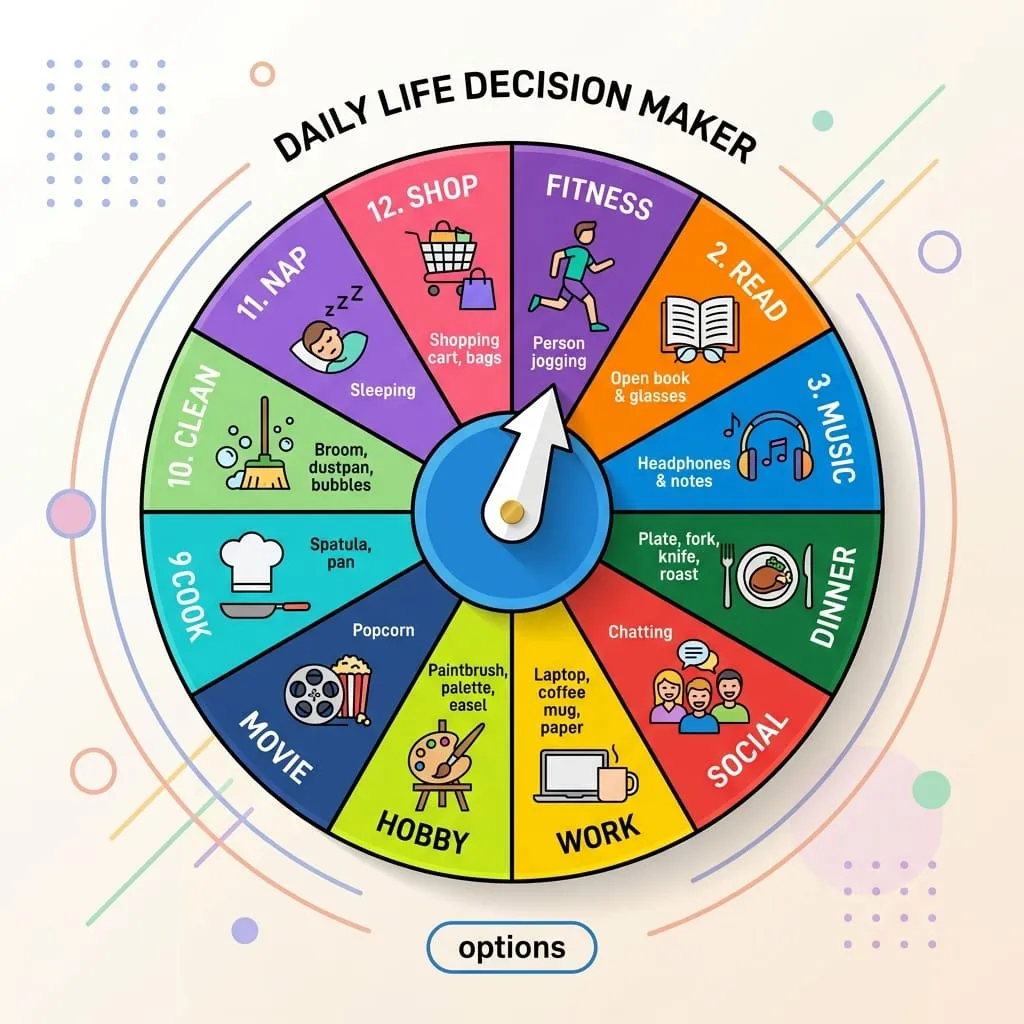
Dave runs our backend team, and last winter his daily morning standups were turning into twenty-minute debates over who had to review giant pull requests or debug database migrations. Nobody wanted the ugly tickets. Engineers would sit on video calls staring at their keyboards, waiting for someone else to cave in and take the hit.
That wasted time drove Dave crazy, so he opened our prototype in Chrome, typed six engineers' names onto the wheel, and clicked spin the wheel to assign the backlog. The arguments vanished on the spot. When a mechanical pointer picks your name, you don't argue with your tech lead because everyone just watched the wheel stop on you.
Across ninety days of tracking ticket assignments, standup debate times dropped from over twenty minutes down to about fifteen seconds. Nobody accused coworkers of favoritism because the picks came straight from browser physics.
Why small dilemmas stall engineering standups.
Standup arguments usually start over trivial tasks. A developer can spend twenty minutes comparing two backlog tickets that have almost identical priority. As covered in research from the American Psychological Association on mental willpower depletion, repetitive decision-making drains focus needed for actual problem-solving. Spending morning energy on ticket assignments leaves less stamina for debugging broken builds later.
Revealing hidden preferences in six seconds.
Spinning the pointer also cuts through personal hesitation. As the dial clicks past each slot, people usually root for a specific wedge without saying it. Watching the arrow approach one name triggers a gut reaction; you instantly realize which outcome you'd rather see, ending thirty minutes of debate.
Defusing social tension during group dinners.
Group dinners run into the same problem. Five people stand on the street corner repeating that they don't care where to eat because nobody wants to take the blame if the food is mediocre. Putting three options on a quick wheel takes the social pressure away completely. The software made the pick, so nobody feels guilty if the taco truck has a long line.
Everyday routines where randomness saves time.
People use our tool for all kinds of daily routines, like picking dinner menus, organizing workout circuits, or picking sprint retrospective hosts. If you want ready-made layouts for household chores, meals, or agile ceremonies, check out our pre-built custom wheel templates.
Binary calls and overcoming analysis paralysis.
For simple yes-or-no forks, a ten-slice spinner is unnecessary. When Dave needs to decide whether to push a hotfix before lunch or hold off until tomorrow, our simple yes or no decision wheel provides a clean coin-toss result in seconds.
As described in the Wikipedia overview of analysis paralysis, spending two hours debating minor tasks kills productivity much faster than simply picking one and shipping it.
Canvas rendering versus DOM lag on older laptops.
When Dave and I first started looking at existing wheel apps on the web, almost every single one was built terribly. They would construct each pie wedge out of individual HTML <div> tags or bulky inline SVG paths. That might run fine on a brand-new M3 MacBook Pro in an air-conditioned coffee shop. But try spinning forty wedges on Dave's older Lenovo ThinkPad T480s or a cheap school Chromebook, and the whole browser chugs. The animation drops to fifteen frames a second, the pointer jerks around like a broken clock, and the suspense is totally ruined.
Not our style.
We wrote our rendering engine from scratch on an HTML5 <canvas> element. Instead of forcing the browser's layout engine to recalculate dozens of overlapping DOM elements during every degree of rotation, the GPU handles a single draw pass per animation frame. It glides at a steady sixty frames per second, even on an eight-year-old budget laptop with five other tabs open.
Hardware entropy under the hood.
Most toy spinners online take shortcuts by calling standard JavaScript Math.random(). That works for elementary school games, but over fifty spins it creates annoying clusters where the same two wedges win repeatedly. When that happens during a sprint standup, engineers immediately assume the app is broken.
We wired our engine into the W3C WebCrypto API instead. The browser calls crypto.getRandomValues() to sample thermal noise and hardware timer jitter directly from the host operating system, giving every slice an identical probability on every spin.
Peg boundary safety buffers.
There's one other nightmare scenario that ruins random picks: the boundary freeze. The wheel spins, slows to a crawl, and the pointer stops squarely on the dividing line between two wedges. In a split second, people start hollering. "It tipped into Chores!" "No way, the shadow is on Tacos!" You've managed to invent a brand new argument on top of the old one.
We fixed that inside our physics loop.
Our wheel code calculates an angular repulsion zone around every dividing peg. If the physics simulation calculates a deceleration curve that would leave the needle within a tiny fraction of a peg boundary, it applies a subtle damping nudge forward or backward into the heart of the nearest wedge. The needle always lands cleanly. Zero ambiguity, zero replays.
How we tested this setup.
We tracked morning standup deliberation logs across Dave's backend squad for ninety consecutive days while logging our Oakland household chore schedules. Alongside that, we ran automated headless Chromium scripts through 50,000 continuous spin cycles on Linux and macOS to verify zero wedge bias across all peg intervals.